
This rule change could transform curling
Is one blank per team the way?

People are coming for the blank end. When the WFG Masters instituted a modified blank rule in January, it got a lot of publicity. The rule stated that the team lost hammer if there were consecutive blanks. The rule had an impact but it was somewhat limited. Overall, blanks dropped from 13.9% of ends to 10.5%.1 First-end blanks dropped from 31.2% to 28.0%.
Last week, the third annual SGI Best of the West event took place in Saskatoon. There was no big-time TV network behind it. And there was no karaoke contest in the evening (at least one that was broadcast). But they tried a different approach to improve game play. Each team could only retain hammer after their first blank of the game. I’m not sure who the genius was that came up with this idea, because there was hardly any news about it. But make no mistake, it was genius and it could be the future of big-time curling.

For one thing, the rule eradicates the transactional first-end blank, the most boring part of curling, and subject of our fifth-ever post on the blog. If you are going to try to sell someone on curling, it’s tough when they sit down to watch a big game and in the first end, nothing happens. Imagine a hockey game where the first 6 to 8 minutes are just a skate-around with neither team trying to score. Well, as the stats from the WFG Masters illustrate, this is that way a big curling game is often played. The best karaoke contests in the world can’t make up for that.
But with the one-blank rule, we have completely solved the issue! As we can see using data from the past three editions of this event for men’s and women’s combined:
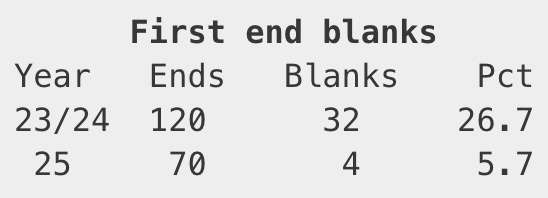
I’m surprised there would be any first-end blanks using this rule. Using your blank in the first end is almost certainly decreasing your chance of winning. It’s actually possible that scoring one in the first end is better than blanking.
On the women’s side, according to true win probability for teams ranked between 26th and 100th in the world, the value of a first-end blank under normal rules is +0.5% and value of a first-end force is -0.2%. If you think the value of saving that blank for later is at least 0.7%, then it’s better to take your one. For the men’s teams ranked in this range, the difference is 5.4%, so it’s more of a question for them, but still a question worth asking.
So if you’re non-hammer, you clearly want to make hammer work to avoid a blank, and therefore want to throw in on your first shot. And if you’re hammer you want to guard on your first shot. And then non-hammer is guarding on its second shot. From there, you have real and actual curling in the first end of every game forever and ever.
Which is mostly what happened in this event. There are 11 games available for viewing on the CurlingZone YouTube channel and I watched the first few stones of the first end in each one. And guess what? Sometimes non-hammer started by throwing in and sometimes they started with a guard, but there were rocks in play in every first end.
But don’t despair blank-lovers because there is still a place for you under these rules. In the Best of the West, there was no noticeable change in scoring distribution from ends 2 to 7 compared to previous years.
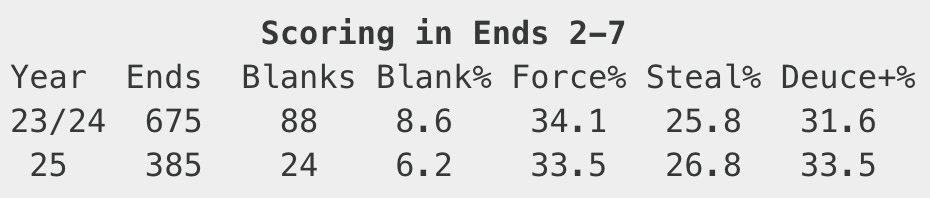
There were just as many big ends and just as many steals as in the past. So there’s good news all around. If you love a well-executed blank later in the game, those still exist.
However, our investigation can’t stop here. Some have suggested a rule that would flip the hammer on every blank. But that would lead to some unintended consequences. Mainly, that non-hammer would play much more defensive. Well, hey, this event provides us with some data on that, too. Let’s only look at ends where hammer had previously used its blank:
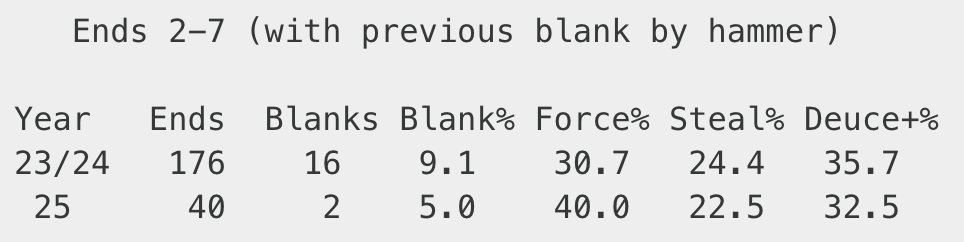
There were just 40 post-blank ends in the entire event (70 games) but the results are about as you would expect. There’s a substantial increase in forces, with 16 of 40 ends ending in hammer scoring one. And really that number is 18 of 40, because somehow there were two blanks in these cases where the team that blanked lost hammer. Sadly, neither of these was on a streamed game, but we can assume they were either missed open draws or failed hit-and-stick attempts. It happens.2
So there might be a trade-off here. You eliminate all of the boredom of the first end while perhaps giving a little of that back in later ends. But that’s the way it has to be if you think the blank is worth something. It’s naturally going to lead to more forces after the blank has been used.
Though, we don’t really know what these extra forces look like, so it’s possible many of them had some rocks in play. With just 40 ends of data, we can’t even be sure these trends are real. We need more data and more testing of this rule. But even with the increase in forces, you had a hardly-noticeable decrease in big ends and steals.
It’s also worth acknowledging that the numbers might look different for the world’s elite teams. The Best of West was limited to younger teams who all ranked outside the top 25, and a few that where outside of the top 100. But in higher-level games, blanks are more frequent. For instance, in games involving Rachel Homan, the first end was blanked a whooping 39.8% of the time (33 of 83 games) this season. And shout out to the GOAT of first-end blanks, Krista McCarville, who gave us 22 blanked first ends in 32 games.
Those would all go away. Homan would have to go reasonably hard for a two in the first end, even when her opponent inevitably throws into the rings, which they currently do anyway out of pure fear. Given the relative ease of forcing hammer in an end after they’ve blanked, this philosophy should probably extend through the first half of the game. And that would be fun to watch. So if the Slams are going to test a rule in an event next year, it absolutely should be this one.
There’s another reason this rule change could be the biggest improvement to curling since the original implementation of the free guard zone. If blanking the first end is now a disadvantage for hammer, then it follows that just having hammer in the first end is less of an advantage than it normally is.
This isn’t obvious from the results of Best of the West, though. In 2023 and 2024, hammer won 54.2% of games (65-55) and this year hammer won 54.3% of games (38-32)3. But if the reduction in hammer winning percentage is truly something like 2%, you’re going to need hundreds of games to see this trend emerge with any confidence. Nonetheless, logically it should happen, and reducing hammer’s winning percentage would also be worth trading for a few more forces.
I think there’s one more benefit from the change. The initial roll-out of this rule would introduce additional strategic mysteries. Win probability would now be defined by score, hammer, ends remaining and if either or both teams had used their blank. There will be more things for teams to consider and more things for spectators to second-guess.
Sure, this rule could fail at the elite level. Maybe it wouldn’t be interesting to see Jacobs and Mouat mightily struggle to avoid blanking in the first half of the game while the team without hammer throws peel weight to keep things open. But given what we saw from the rule last week, it’s worth trying out. For the first time in curling’s history, teams were forced to play real curling from the first rock of the game. That’s an upside that can’t be ignored.
Excluding last or extra ends.
It apparently happened to Ryan Jacques twice in the same game. In Team Jacques’ last pool play game, they blanked both the first and second ends.
The Best of the West also employs a draw to the button to break ties in pool play games. This also figures to reduce hammer’s winning percentage slightly from conventional games.
Wow - a simple change that could have a big impact.
Now this is a rule change worth exploring! The "every blank should flip the hammer" idea that tends to be the first go-to for curlers/fans who don't like blanks would have some dramatic unintended consequences, as you've noted - enough so that I think it would lead to a far less interesting game for very little benefit. But this rule adds an additional layer of strategic tension (rather than removing the most important one in the game), requires more decision making, and won't significantly impact most games.
As CTJ (who posted as I was writing this) notes, other changes to the game might be as effective and less disruptive, and we should probably experiment with them as well.